



- Blog
- Demystifying The 72-Hour Clause, Home Decorating And Choosing Between Freehold Or Condominium
Demystifying The 72-Hour Clause, Home Decorating And Choosing Between Freehold Or Condominium
 December 12, 2024
The 72-Hour Clause
The 72-Hour Clause in real estate, also known as an escape clause or kick-out clause, is a contractual provision that allows the seller of a property to continue marketing the home and accept backup offers, even after accepting a buyer’s contingent offer. Here’s how it works:
Key Features of the 72-Hour Clause :
-
Contingent Offers :
- The clause is often included when a buyer’s offer is contingent on the sale of their current home or another condition that may take time to resolve.
- These contingencies create uncertainty for the seller, which the 72-hour clause seeks to address.
-
Seller Flexibility :
- While the contingent offer is active, the seller can continue to show the property and entertain other offers.
-
Notice Period :
- If the seller receives another acceptable offer, they notify the original buyer, typically giving them 72 hours (or another agreed-upon timeframe) to remove their contingency (e.g., sell their existing home) or risk having their offer terminated.
-
Buyer Decision :
- Within the 72-hour period, the original buyer must decide whether to :
– Remove the contingency (possibly by securing alternative financing or taking on more risk).
– Withdraw from the transaction, allowing the seller to proceed with the new offer.
- Within the 72-hour period, the original buyer must decide whether to :
-
Effect on the Transaction :
- If the original buyer removes the contingency, the contract continues as planned.
- If they don’t, the seller can cancel the contract and move forward with the new buyer.
Benefits of the 72-Hour Clause :
- For Sellers :
– Provides flexibility and reduces the risk of being stuck in a lengthy contingent sale.
– Keeps the property active on the market, maximizing opportunities to find a non-contingent buyer. - For Buyers :
– Allows them to make an offer even if they have an unresolved contingency, such as selling their current home.
Potential Drawbacks :
- For Buyers :
– Adds pressure to resolve contingencies quickly, which might not always be feasible. - For Sellers :
– If no better offers materialize, the seller may still be tied to the original contingent offer.
The specifics of the 72-Hour Clause can vary depending on the contract and local real estate laws, so both buyers and sellers are advised to consult their real estate agents or attorneys to understand the implications fully.

Freehold vs. Condo: Choosing the Right Ownership Style
Condos, short for condominiums, are unique residential options that offer private living spaces within a shared community. While many people associate condos with high-rise buildings, they can also take the form of town homes, row houses, or other architectural styles.
What makes condos distinct is their ownership structure: the interior of each unit is individually owned, while common areas like pools, gyms, elevators, and parking lots are collectively maintained by all unit owners. However, this shared responsibility comes with condo fees, which cover the upkeep of these amenities and communal spaces.
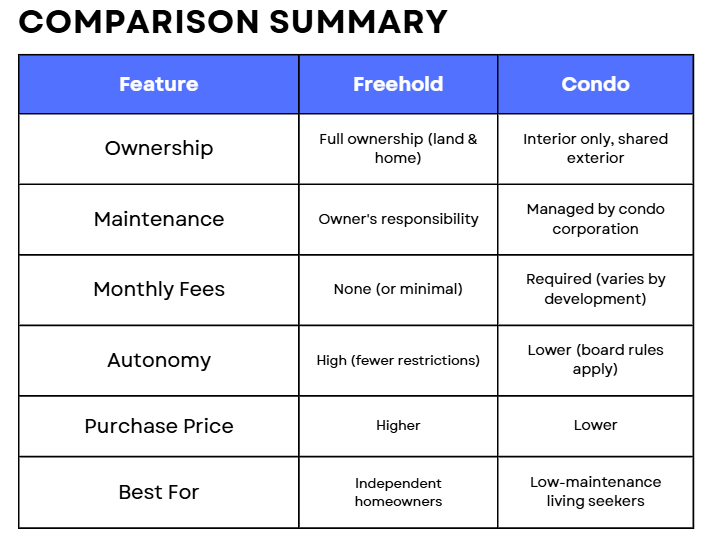
When purchasing a co-op, you aren’t acquiring any physical land. Instead, you’re investing in shares of a corporation that owns the property. This unique arrangement means that securing a mortgage for a co-op can often be more challenging compared to other property types.
On the other hand, freehold ownership grants you full ownership of both the land and the structure, with no shared or communal areas to manage. While this ownership model is commonly associated with detached or semi-detached homes, it can also apply to certain town homes, offering flexibility for buyers seeking full control over their property.
Additional Considerations :
- Future Value : Freehold homes often appreciate more over time due to full ownership of the land.
- Lifestyle : If you travel frequently or prefer a “hands-off” approach to property maintenance, a condo may be a better fit.
- Fees & Restrictions : Be sure to review condo bylaws and fee structures to avoid surprises.
- Future Value : Freehold homes often appreciate more over time due to full ownership of the land.
- Lifestyle : If you travel frequently or prefer a “hands-off” approach to property maintenance, a condo may be a better fit.
- Fees & Restrictions : Be sure to review condo bylaws and fee structures to avoid surprises.
Talk to your real estate agent or a lawyer to ensure you fully understand the specific terms and costs associated with any town home or row unit you’re considering.
Decorating Rules: What’s Allowed When You Own Your Home
Once you own your own home, you have significantly more freedom to decorate and personalize it compared to a rental. However, there are a few potential limitations to keep in mind:
Interior Decorating
- No Restrictions for Freehold : In a freehold property, you can decorate, paint, and renovate the interior as wildly as you like (e.g., bold colors, custom installations).
- Condo Considerations : If you buy a condominium, interior changes might be restricted to ensure structural integrity or to comply with condo bylaws. For example, you might need permission for major renovations, like knocking down walls.
Exterior Decorating
- Freehold : You have full control over the exterior in a freehold property. However :
– Municipal Regulations: Local bylaws may limit extreme changes, such as specific fence heights, colors in heritage zones, or prohibited materials.
– Homeowners’ Associations (HOAs): If your home is part of an HOA, you might need to follow their rules about exterior appearance. - Condo : Exterior changes are generally controlled by the condo board, so you may not be allowed to alter your unit’s outward appearance.
If you want to go all-out with bold colors, murals, or unique landscaping, a freehold property is your best bet for creative freedom. Just check for any local or neighbourhood-specific rules before starting exterior projects! Once you’re sure there are no regulations or restrictions holding you back, go ahead and let your creativity shine with all the colors you love!
Recent Post